
One of the delights of owning an Onoto pen is the individuality that can be expressed by choosing the type of nib that fits your writing style and the colour of ink. Your personality will show through not just in the words you use, but the visual picture you paint. Your choice of nib should depend on your syle and speed of writing. If you write quickly or deal with numbers, you will find a fine nib suites you more. If you are more leisurely in your writing or like to create an impact, a medium or broad nib will fit the bill. Over time and use, the nib adapts to your individual writing style which will feel even smoother. That is why you should not let others use your fountain pen.
Available in 3 sizes:
- Size 8 nibs are our largest measuring 10.0mm wide and are exclusive to our Mammoth range.
- Size 7 nibs are our medium nibs measuring 8.4mm wide, and are standard in the larger Onoto pens including Centenary, Nelson, Magna, Magna Classic, Cambridge pens, Royal Ballet Contemporary, Churchill range, Magna Plunger-filler, Diamond Jubilee, Dickens, Aviator and Doctor’s pens.
- Size 3 nibs are our smallest measuring 7.5mm wide, and are standard in the smaller Onoto pens including Emma Hamilton, Royal Ballet Aspiration, Excel, Burlington, Heritage Plunger-filler and Overlay No 1 pens.
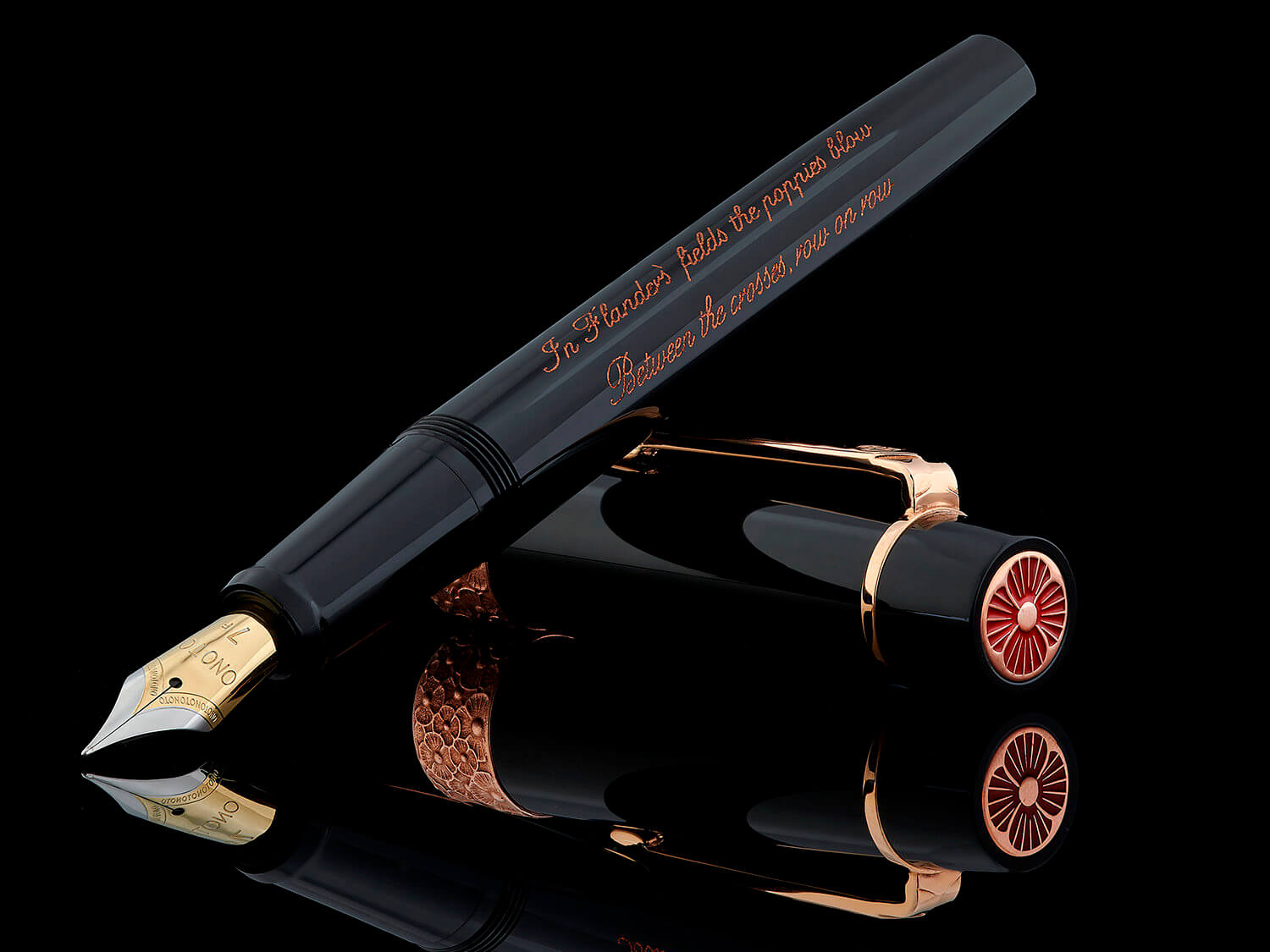
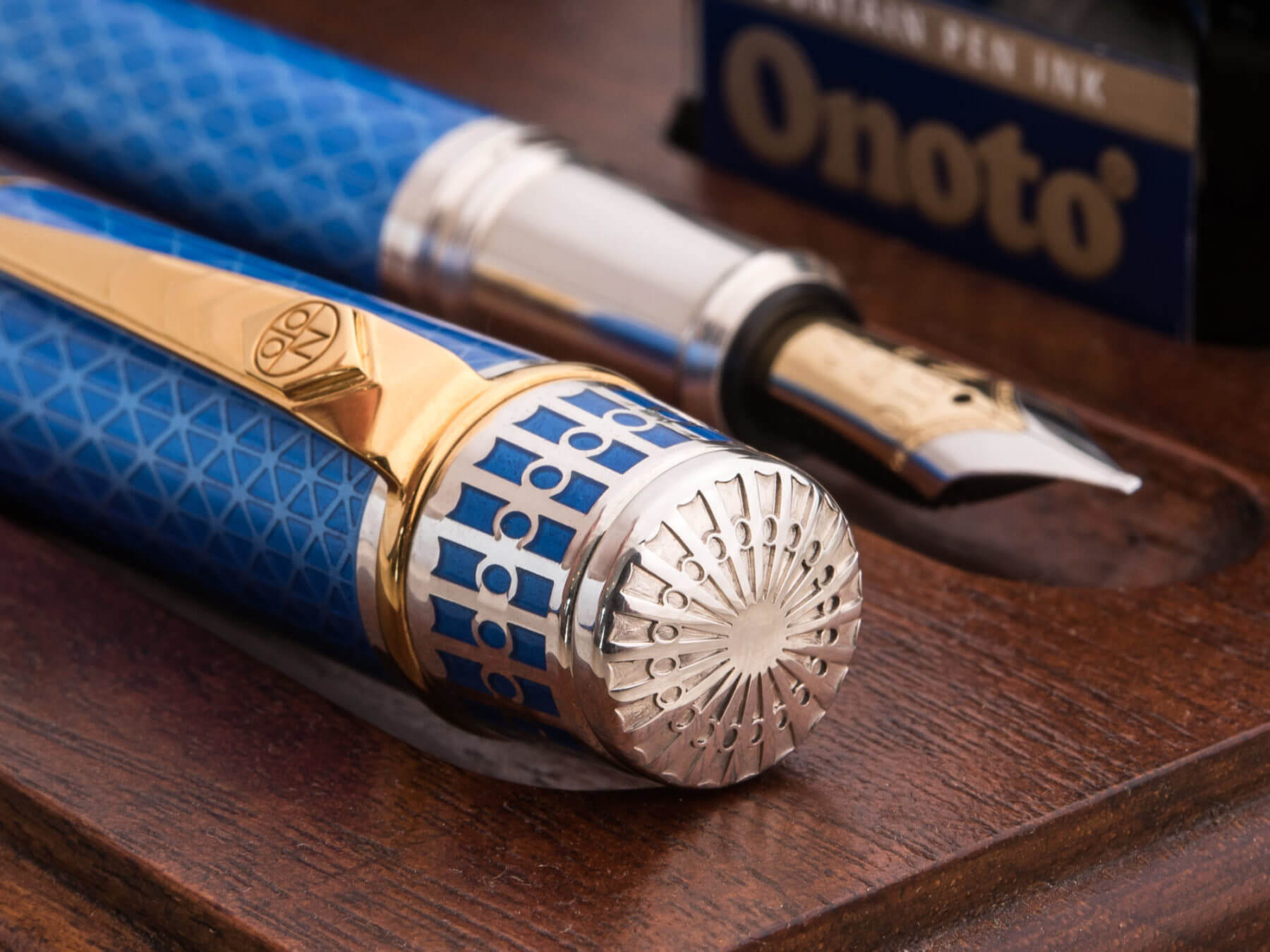
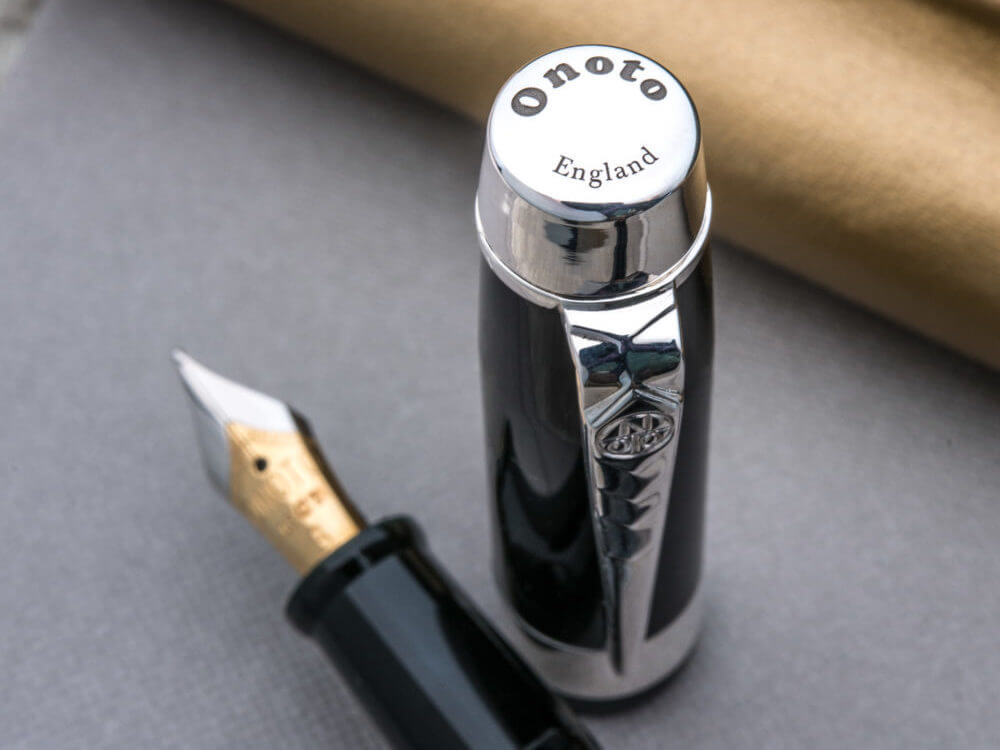
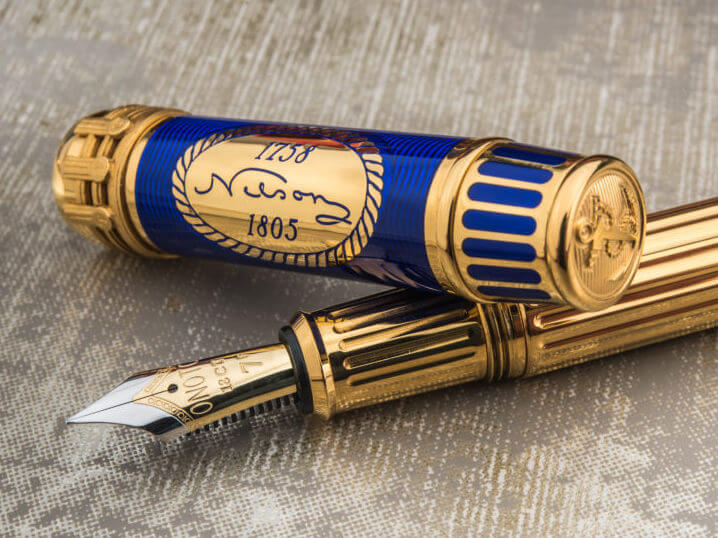
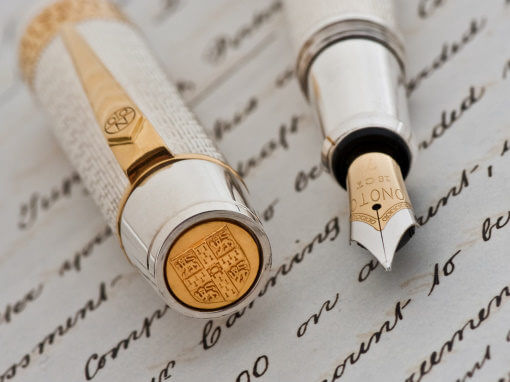
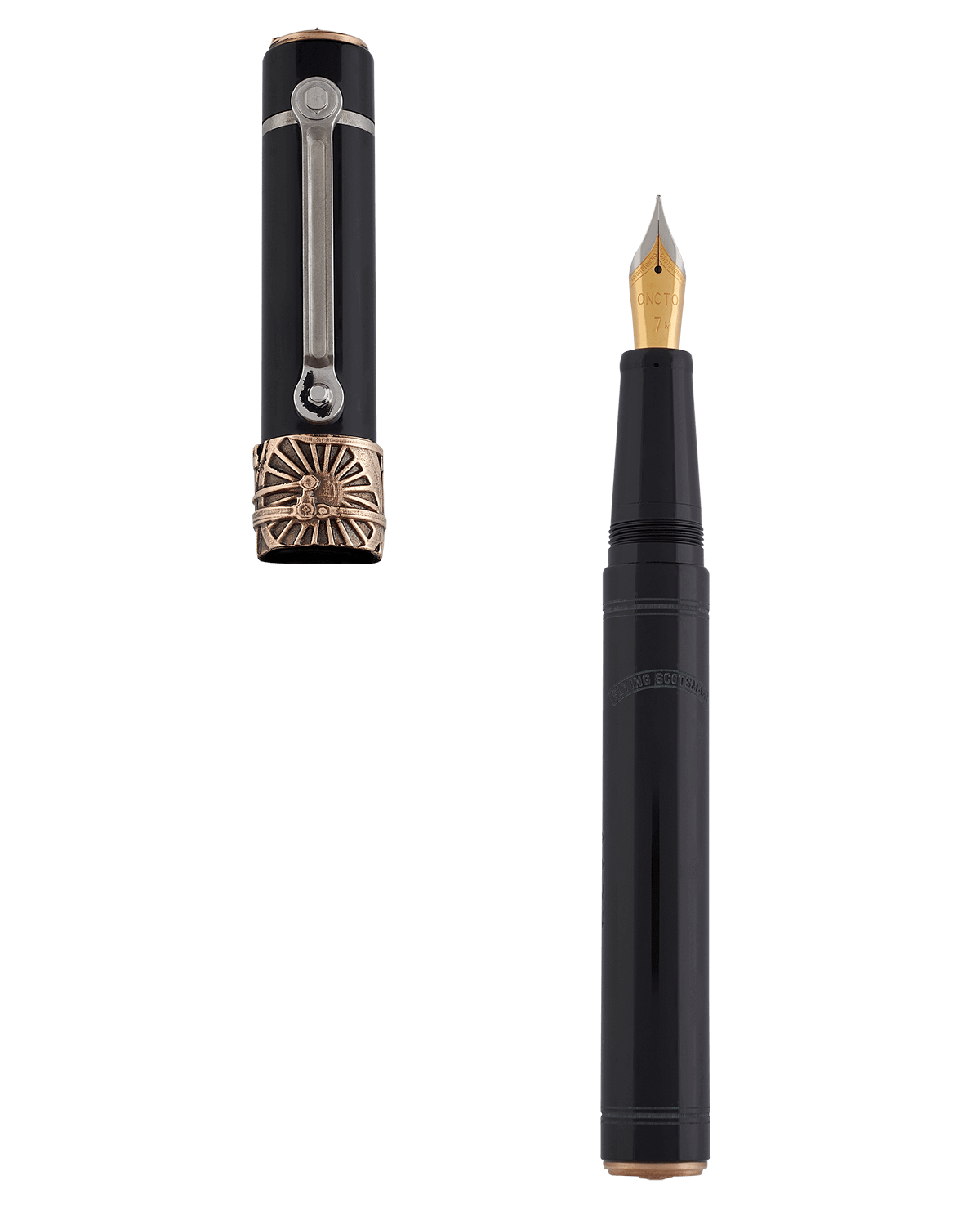
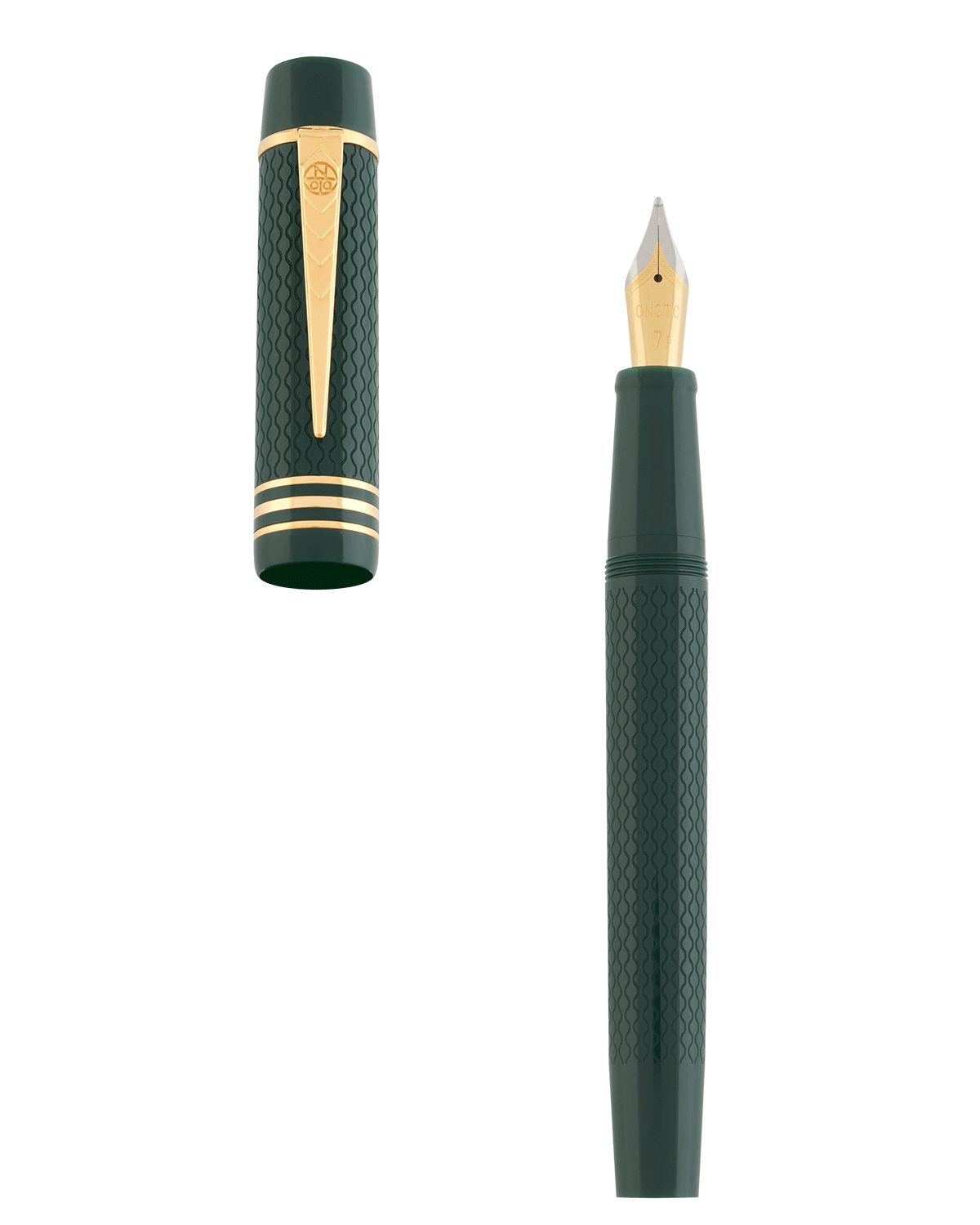
Each nib is engraved with the Onoto name, an exclusive Onoto pattern, and the nib size 3, 7 or 8. The latest nibs also have the width (F, M or B) engraved next to this figure.
Both the 18ct gold nibs, and the gold-plated stainless steel nibs are two-tone colour and rhodium plated, and have an iridium tip for smooth writing and long life.
For each size of nib, you can select from fine, medium, or broad width. Except for the Size 8 which is only available in Medium and Broad. These are the widths of the writing lines:
- Fine produces approximately a 0.3mm – 0.4mm wide line of ink
- Medium produces approximately a 0.5mm – 0.65mm wide line of ink
- Broad produces approximately a 0.7mm – 0.9mm wide line of ink
The thickness of the line depends on the pressure exerted on the pen, and the type of paper. As a rule, a broad nib suits large handwriting and flowing signatures, fine nibs suit smaller handwriting and figure work. Broad nibs can tend to fill in the spaces in “b”, “d”, “e”, “6” etc if you handwriting is small. Medium nib is a good compromise, and selected by the majority of fountain pen users.
In addition to the standard fine, medium and broad Onoto nibs, there is an option to customise any nib to your own specification at an extra cost. For example, if you prefer to write with a Stub, italic or oblique nib, our nib wright, one of the UK’s most experienced nib mechanics, will undertake the work to your exact specification. Just include full details when you select the ‘custom nib’ preference in the shopping cart. You will find full details below of the various custom nib options and how they affect your writing.
In addition, our nib wright can grind virtually any style, including Arabic and calligraphy nibs to order, although there may be an additional charge for this service. Please contact us if you have a specific request.
There are three basic nib shapes or styles: Round, stub, and italic.
Round Nibs: A round nib is ground and polished to have roughly a circular footprint, so that its line width is fairly uniform no matter what direction the nib is moving across the paper. Here is a magnified silhouette representing the basic shape of a round nib. All standard Onoto nibs are Round Nibs.
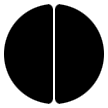
Stub Nibs: A stub nib is elongated sideways, to have a footprint that is somewhat elliptical. This makes it lay down a slightly broader line when moving up and down (in relation to the nib itself) and a narrower one when moving sideways (again, in relation to the nib). The wider line is between 1.5 – 2.5 times thicker than the thinner line in our custom Onoto stub nib. The eccentricity of the ellipse isn’t too pronounced, and the nib is still polished to have nice rounded edges. This means that you can write with a stub just about as easily as with a standard nib. Here is a magnified silhouette representing the basic shape of a stub nib.
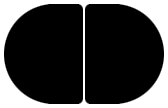
Italic Nibs: An italic nib is much more elongated. This makes the difference between its broad (up-and-down) strokes and its narrow strokes (sideways) much more pronounced than with a stub. The wider line is between 2.5 – 3.5 times thicker than the thinner line in our custom Onoto cursive italic nib. Here is a magnified silhouette representing the basic shape of an italic nib.

A traditional italic nib has a perceptible straight edge across the tip, and relatively less rounding to the edges than a stub nib. This result in a greater tendency to catch on corners and to skip if the nib is not held straight-on to the paper. This can make the nib feel “scratchy”. However, there is a compromise grind called cursive italic, which has more rounded edges than a traditional italic. When properly ground and finished, a cursive italic nib can produce stroke variation almost as a as an italic nib while the writing feel is nearly as smooth as a stub of similar width. All Onoto italic nibs are cursive italics unless otherwise requested.
To write text where the line width variation adds character and beauty to your writing, and resembles handwriting of yesteryear.
When you write with an italic nib, you hold the pen with the nib generally away from your forearm (as with a stub or a round nib). When used by a right-handed person, an italic nib will generally make strokes that are of roughly equal width in both the vertical and horizontal directions; strokes from the upper right to the lower left will be thinner, and strokes from the upper left to the lower right will be thicker.
This is the stroke arrangement most commonly seen in Old English and in many italic and Chancery styles.
Calligraphy nibs have the same shape as italic nibs (i.e. elongated), but might be even wider, and are finished with squarer edges. This square-edged grind and the wider footprint result in a greater tendency to catch on corners and a greater tendency to skip if the nib isn’t held straight-on to the paper (i.e. when one side of the nib lifts away due to the nibs being rocked sideways). Writing too rapidly with a calligraphy nib tends to produce scratchiness and skips. However, by writing more slowly, calligraphy nibs give a very crisp and controllable line width, and with practice, some writers become very proficient with calligraphy nibs, producing beautiful text. Onoto can grind specialist calligraphy nibs on request.
Left-handed writers use so many different writing styles, overwriting and underwriting, writing uphill, writing horizontally, and writing downhill, that it’s not really possible to recommend any one nib. Experimentation on what works for you is the only answer!
An oblique is ground so that the writing tip contacts the paper properly when the pen is rotated in the user’s hand. This suits some handwriting better.
When you write with an oblique, you change the orientation of the pen in order to make the nib’s flat surface contact the paper. A left oblique, when used by a right-handed person, will be rotated counter-clockwise in the writer’s hand – see drawings below: (the rotation depicted is exaggerated for illustration)
There is some confusion over what is a left oblique, and right oblique, so a good way to remember it is as follows:
Normal nib
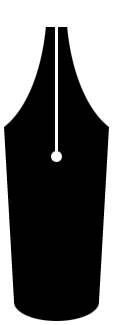
Left oblique
Looks like a left foot from above considered to be more suited to a right-handed person
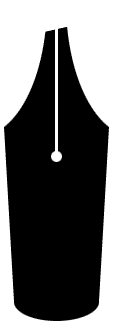
Right oblique
Looks like a right foot from above considered to be more suited to a left-handed person
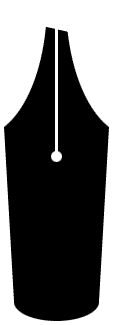
A left oblique is the most common style used by right-handed people. Many modern oblique nibs are ordinary round nibs, not designed to produce line variation.
However oblique italic nibs are still common, which are designed to produce line variation, and they are exactly like an italic nib except that it is cut on a slant. There are 2 most common slants: 15 degrees (half) or 30 degrees slant (full). The custom Onoto Oblique nib held in stock is a left oblique cursive italic with a 15 degree slant.
A duo-point nib is like a standard round nib, but it is also ground and polished so that you can write with it while holding the pen with its nib on the underside instead of in the usual nib-uppermost orientation. This gives a finer line, so that you can have, in effect, two different nib sizes on one pen. All Onoto medium 18ct gold nibs are designed as Duo-nibs – medium nib one way for normal writing, fine nib the other way for figure work. We can also grind most of our Onoto nibs to be Duo-Point nibs.